
Inside Kesler's student data · Study 06
Do You Need to Relearn Everything During CPA Final Review?
The myth: final review is when you panic, reopen chapter 1, and relearn the entire CPA course.
One rough quiz and suddenly every chapter looks suspicious. You start making a plan to redo everything. The plan is ambitious. It also appears to require a second calendar.
Our recommendation: diagnose before you restart. Sample across your section, identify the gaps, and concentrate your repair work there. Keep stronger topics in maintenance and give uncertain ones another check. Your final-review plan should get more specific as you collect evidence.
Two selected Kesler students who reported AUD passes recorded substantial Study Funnel practice: 624 and 156 scored answers. Their funnel percentages tell very different stories. Those differences are useful if you've been treating every lower quiz score as an instruction to start over.
These are selected reporting students, not all Kesler users or everyone who passed with Kesler. The histories show funnel activity alongside reported outcomes; they don't reconstruct each student's final-review schedule or which topics they filtered out. Sample and methods.
Final Review Should Narrow the Work.
A Kesler Study Funnel starts with broad practice, helps identify weak areas, then directs attention toward targeted review and retesting. You funnel stronger topics out of the immediate repair list so they don't consume the same attention as an unresolved gap.
That doesn't mean deleting strong topics from your preparation. It means spending less repair time there while keeping later and mixed checks. And “strong” needs evidence: one correct answer you guessed does not qualify.
-
Sample Broadly
Check across your exam section. Include topics with little recent evidence, not just the sets you like taking.
-
Sort the Evidence
Use correctness, confidence, and your reasoning to separate urgent gaps, uncertainty, and stronger work.
-
Repair the Gap
Revisit the specific lesson, explanation, or distinction. Write what you will do differently on the next question.
-
Recheck and Reprioritize
Test the reasoning without notes. Move stronger topics into maintenance; keep unresolved ones in focused review.
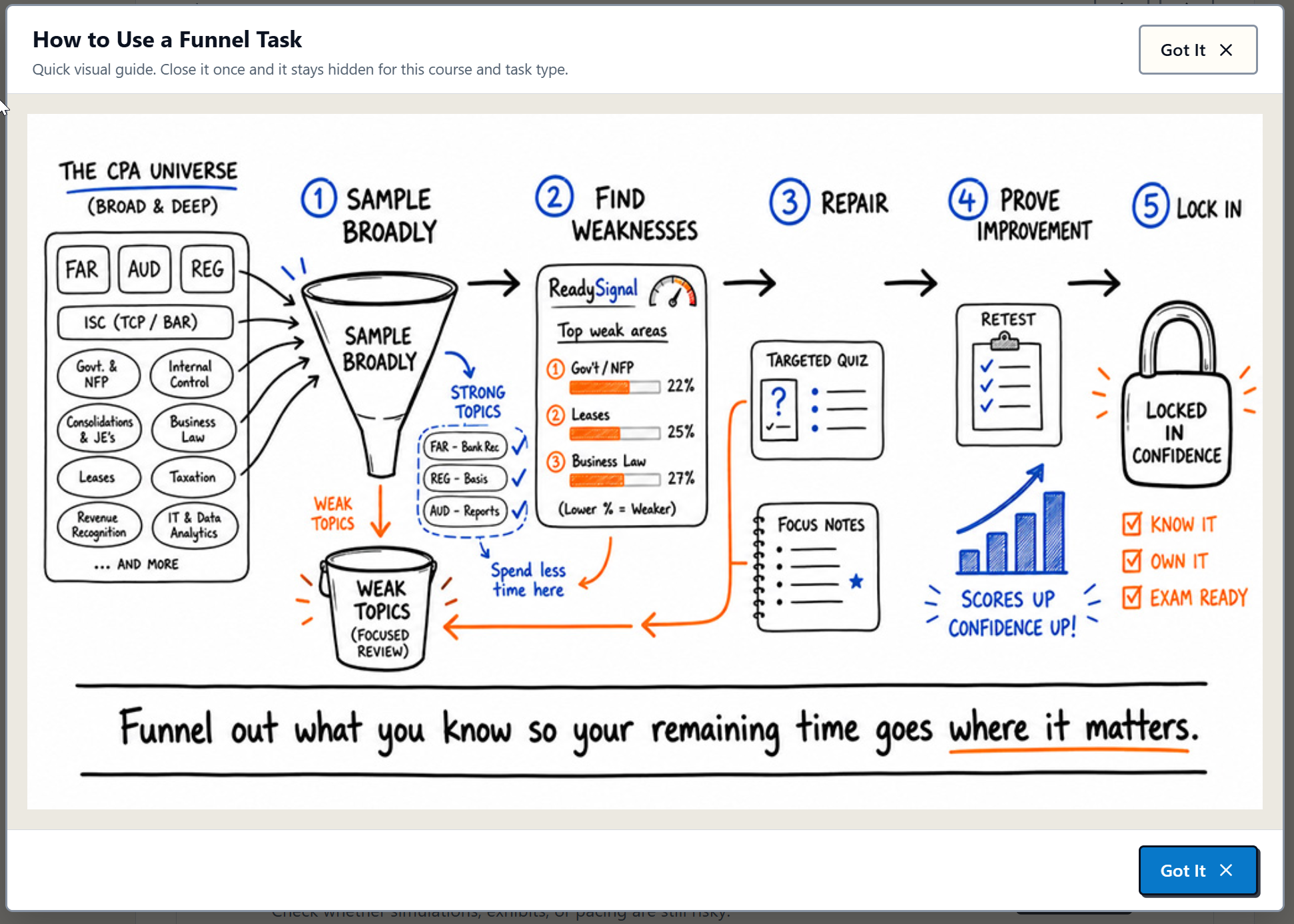
A Retake Study Funnel applies the diagnosis-and-repair workflow after an unsuccessful attempt. A Study Loop is a return to a topic through a mini-assessment and weak-area review. Use loops to follow up on the gaps your broader review exposes. The funnel helps narrow your priorities; the loop gives a topic another check.
Two AUD Passes Included Substantial Funnel Practice.
Example A · AUD
Reported Pass: 76
624 scored funnel/retake answers across 16 recorded funnel/retake sessions, alongside 356 study-task answers.
Example B · AUD
Reported Pass: 79
156 scored funnel/retake answers across 4 recorded funnel/retake sessions, alongside 728 study-task answers.
Example A recorded more funnel/retake answers than study-task answers. Example B recorded fewer. Both reported an AUD pass. There isn't one question-count recipe hiding in these two histories.
The export combines Study Funnel and Retake Study Funnel activity. We can describe their combined use, but cannot say each student used both formats or assign every answer to a particular review phase. Recorded sessions aren't necessarily different days.
In the broader selected sample with at least 200 multiple-choice questions (MCQs) answered, funnel activity appeared in 23 of 31 passing section records and one of six non-passing records.
Study Funnel Activity Within Each Outcome Group
That non-passing AUD example reported 52 and recorded 199 funnel/retake answers across six sessions in the detailed history. Using the tool alone isn't a guarantee. The five other non-passing records have no recorded funnel activity; that does not establish that those students never used it.
What this changes for you: the passing histories give concrete examples of targeted-review activity alongside learning practice. Build room for diagnosis and repair in your own review plan. The records cannot tell us whether these students avoided a full restart or prove that funnel use caused their passes.
A Lower Funnel Percentage Isn't an Instruction to Restart.
Two AUD Passes, Different Funnel Accuracy Patterns
Example A · AUD
Example B · AUD
Example A's funnel accuracy was higher than study-task accuracy. Example B's was lower, despite the reported AUD pass. Across 23 paired passing section records from 14 students, task accuracy averaged 3.84 percentage points higher than funnel accuracy.
These are comparisons between quiz types, not scores measured before and after an intervention. Weak-area selection and repeated questions can change what a percentage represents. We can't separate their effects in these records.
So don't automatically translate “my funnel score dropped” into “I forgot everything.” Open the questions. If the misses cluster around a specific distinction, give that distinction the next repair block. If gaps appear across many topics, expand the review. The scope of the evidence should determine the scope of the repair.
The reverse matters, too. A high retake percentage may include familiar questions. Close the explanation, explain the rule, and try a fresh question where available. Recognizing option C is not the same task as recognizing why option C works.
Two Red Flags Belong in Your Review List.
Kesler's confidence choices are Guessing, Maybe, and Confident. Use them honestly. Correctness tells you what happened; confidence helps you interpret whether the result reflects understanding, uncertainty, or a mistaken rule you trusted.
Red Flag · Confident + Wrong
Investigate the Rule You Trusted.
Find the assumption or condition that led you astray. Review it, explain why your original answer fails, and put that distinction into the next targeted check.
Red Flag · Guessing + Correct
Keep the Lucky Answer Visible.
A green mark doesn't resolve the uncertainty. Identify why the correct answer works and why the tempting alternative doesn't. Give the topic another unaided attempt.
Maybe is useful data, too. If you narrowed it to two choices but couldn't explain the deciding fact, record that uncertainty. Don't promote the topic to “strong” just because the coin landed your way.
Kesler's ReadySignal uses mapped accuracy, confidence, quiz history, and coverage to help prioritize review. It needs enough evidence and honest inputs; it does not predict your CPA exam score. A topic with almost no practice needs sampling before you classify it.
Keep your original confidence separate from confidence after reviewing an explanation. “That makes sense now” is a good starting point for a later check. It isn't evidence that you could have solved the question unaided. See the confidence-controls walkthrough.
The student exports do not include historical item-level confidence ratings. This is our recommended use of the controls, not a measured explanation for these students' outcomes.
Replace the Restart Plan With Three Review Lists.
After your next broad check, sort the topics below. These are planning categories you can use in Kesler or your own notes, not automatic product thresholds.
01 · Repair Now
A Gap You Can Name
Confident mistakes, repeated misses, or a rule you cannot explain. Revisit the relevant lesson and write the correction before taking another set.
02 · Check Next
Uncertainty to Resolve
Guessed-correct answers, Maybe ratings, thin topic coverage, and recently repaired concepts. Use fresh practice or a Study Loop to find out what holds without help.
03 · Maintain Later
Strength With Evidence
Correct reasoning that holds on fresh or later checks. Reduce immediate repair time here, retain mixed review, and move it back if new evidence exposes a gap.
Move a topic because of demonstrated reasoning, not because you're tired of seeing it. There is no magic number of answers in this dataset that earns permanent graduation from review.
A hypothetical AUD session: your mixed set goes well on report wording, but you confidently miss a question about which procedure addresses an assertion. Keep report wording in maintenance. Put the assertion/procedure distinction in repair now. After reviewing it, use a Study Loop or fresh targeted questions to check it again. If you can explain the reasoning later without notes, reduce its priority. You've built a specific next session without reopening every AUD lesson.
- Start from a broad view of your section. Look at recent mixed practice, unresolved questions, and topics with little evidence. Don't build the entire plan from your favorite chapter or one bad quiz.
- Choose the repair before choosing more questions. Write the exact distinction. Use the relevant lesson or Learn N GO MCQ Explanation, then explain the correction in your own words.
- Make the next loop answer a question. “Can I apply this rule without notes?” is a useful goal. Record the result and confidence. If the gap remains, keep it in focused review; if the reasoning holds, move it toward maintenance.
- Keep exam rehearsal in the plan. Preserve mixed practice, task-based simulations (TBSs, or sims), and mock-exam timing work. Strong isolated MCQs don't show how you handle a multi-step simulation or a full session.
Your Next Final-Review Session
Evidence that changed my priority: ______
Specific topic or distinction to repair: ______
What I'll explain or apply without notes: ______
Next Study Loop or fresh check: ______
Stronger topics and rehearsal I'll maintain: ______
The better recommendation: sample broadly, repair specifically, and recheck honestly. Funnel stronger topics out of today's repair work while keeping them in your review rotation. Let your own results and confidence decide where the next Study Loop spends your attention.
If your checks reveal gaps across the section, a broader rebuild may be appropriate. The point is to earn that decision with evidence instead of treating panic as a study-plan feature. For an unsuccessful attempt, use our retake-planning guide to investigate more than content alone.
Give Your Next Review Session a Specific Job.
Explore the Kesler CPA Review Free Trial to inspect the study workflow and explanations. The trial is a limited preview, with paid content behind an in-app paywall.
Explore the Free TrialSample, Sources, and Limits
First-party analysis by Kesler CPA Review using selected student-reported outcomes and retained product activity. Comparison snapshot: September 29, 2026, 12:45 UTC. Outcomes are self-reported, not independently authenticated in this analysis.
Read the Data Tables and Measurement Details
| Example / Reported Result | Study Tasks | Funnels / Retakes |
|---|---|---|
| A · AUD pass, 76 |
356 answers 70.5% accuracy |
624 answers 87.5% accuracy 16 sessions |
| B · AUD pass, 79 |
728 answers 61.4% accuracy |
156 answers 52.6% accuracy 4 sessions |
| C · AUD non-pass, 52 |
654 answers 61.6% accuracy |
199 answers 55.8% accuracy 6 sessions |
| Reported Outcome | Records with Funnel Activity |
|---|---|
| Pass | 23 of 31 |
| Non-pass | 1 of 6 |
- Sample: selected Survivor submissions from paid-use customers. The 200+ recorded-MCQ subset contains 26 students and 37 current section results: 31 passes and six non-passes. A student can contribute multiple sections. This is not all Kesler customers or all students who passed with Kesler. No population or feature-user pass rate is calculated.
- Selection: the two passing AUD examples show contrasting task/funnel patterns. The non-passing AUD example is a counterexample, not a matched control. Anonymous analytical rows are not testimonials. Recruitment and submission-incentive details were not established.
- Quiz types: funnels and retake funnels are combined. Counts include scored answers through the reported exam day, potentially including repeats and earlier cycles. They are not unique questions, hours, or completed assignments. Session counts do not establish days or final-review timing.
- Two data layers: the usage chart uses normalized analytics. Detailed profiles may include recovered history: the non-passing example has 199 funnel answers including 30 recovered, versus 169 in normalized analytics. These layers are not interchangeable or combined into answer shares.
- Paired calculation: calculate task accuracy minus funnel accuracy from correct/scored counts for each passing section with both types, then average with equal weight per section: 3.84 percentage points across 23 sections from 14 students. Repeated students are not independent observations. Different question sets and repeated attempts prevent interpreting this as before/after learning.
- Limits: prior preparation, other resources, question selection, difficulty, and timing are uncontrolled. Missing recording isn't proof of nonuse. The exports do not identify the topics students filtered out, historical item confidence, anxiety, or first-to-repeat improvement. No claim that funnels caused passing, saved a measured amount of time, or established exam readiness.
Three source hashes and three copied profiles matched their originals; aggregate fields and example arithmetic were reconciled; the paired difference was independently recomputed. These checks establish file consistency, not official authentication of reported scores.
Prepared with AI assistance and checked against retained sources on September 29, 2026. Product workflow checked against the current course-trial walkthrough. No separate human expert review is claimed. The sorting board, confidence decisions, and session plan are editorial recommendations, not interventions tested in this sample.