
The CPA course trial checklist
Before Buying a CPA Review Course, Check These 10 Things
Before you buy a CPA review course, use its trial to test the work you'll actually do: plan tonight's session, learn a difficult concept, repair a missed question, and come back to material you haven't seen in a while.
A list of lectures, textbooks, questions, and flashcards can't answer the question that matters at the end of a workday: Will this help me make progress when I'm stuck? These ten tests give you something concrete to try in Kesler, Becker, UWorld, Gleim, or the course you already own.
You don't need a course that wins every category. You need a study process you can use, with a way to fix the gaps that matter to you.
Disclosure: I created Kesler CPA Review. Some course links below are affiliate links, and I may earn a commission if you purchase through them. Apply the same tests to every course, including mine.
Watch the ten-test walkthrough with examples from Kesler CPA Review. Each test below also links to its chapter on YouTube.
For concrete Kesler examples to inspect, Ask Kes shows sources and supports follow-up questions, while Big Day Ready makes preparation targets visible. Test whether those workflows help you decide what to study next; their existence does not establish an outcome advantage.
The 10 tests at a glance
Choose your exam section and a topic you genuinely find difficult. Give each course comparable study time, then write down what happened. A sales-page promise alone isn't evidence that a workflow helps you.
Mark each test Pass when you observe useful evidence, Needs work when the workflow leaves your problem unresolved, or Not verified when trial restrictions or limited practice history prevent a fair judgment.
| Test | What to verify |
|---|---|
| 1. Daily study plan | You can name today's task and see where review fits. |
| 2. Another explanation | A second explanation helps you apply a difficult concept. |
| 3. Learning from misses | A wrong answer leads to repair and a fresh attempt. |
| 4. False confidence | You can separate understanding from guesses and familiar answers. |
| 5. Cumulative review | Earlier material returns while you move forward. |
| 6. Next study priority | Your results point to a useful next action. |
| 7. Simulation execution | You practice requirements, exhibits, timing, and application. |
| 8. Final review | You can diagnose, repair, retest, and rehearse. |
| 9. Retake planning | Fresh evidence changes the plan after a failed attempt. |
| 10. Real-life consistency | You can complete useful work on a busy evening. |
Watch test 1 on YouTube · 01:12
1. Does it tell you what to study today?
You open your course and see months of material. Where do you start tonight? A useful plan turns that library into specific work and leaves room to return to earlier topics.
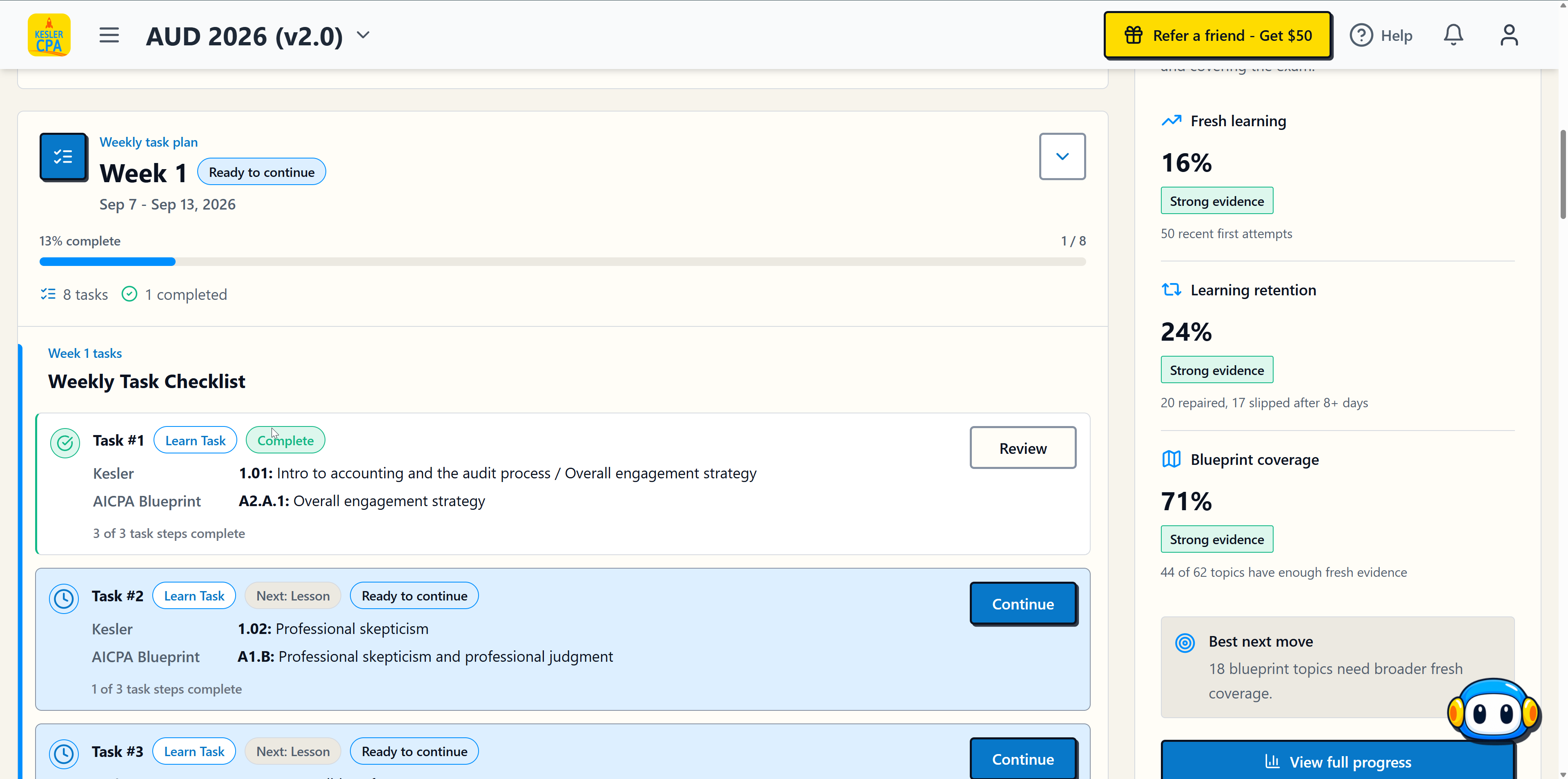
Try this: Enter your exam section, target date, and realistic weekly availability. Open the next session. Identify what you'll learn, when you'll review older material, and where final preparation begins.
Evidence of a pass: You can name today's task and explain how it fits into the rest of your preparation.
In the Kesler example, Learn tasks, Study Loops, and Study Funnels have different jobs. Inspect those jobs, not just the calendar. If the suggested workload won't fit your actual week, resolve that mismatch before committing.
Watch test 2 on YouTube · 03:13
2. Can it explain a difficult concept another way?
You watched the explanation. You still couldn't explain the idea to someone else. Replaying it may help, but your trial should show what else you can try.
Try this: Pick a difficult topic. If the first explanation doesn't click, try another format. Close it and answer a fresh multiple-choice question (MCQ) on that concept.
Evidence of a pass: The second explanation helps you apply the rule and explain why your answer works.
Kesler's Study Notes, Bite-Sized Video Lessons, Audio Notes, and Textbook provide different ways into the material. You don't have to consume all of them. If a longer lecture gives you the depth you want, include that preference in your comparison. The test is what you can do afterward. For an example of combining formats, see how to use Audio Notes alongside active practice.
Watch test 3 on YouTube · 05:08
3. Does a missed question help you learn?
Read the answer. Click next. Miss the same idea tomorrow. To interrupt that pattern, you need to identify the rule you misunderstood and give yourself another chance to use it.
Try this: Review a missed question. Write one sentence explaining your error and one explaining the correct reasoning. Save an unresolved issue, then attempt a different question testing the same concept.
Evidence of a pass: Feedback helps you repair your reasoning and transfer it to a new question.
Kesler's Learn N GO MCQ Explanations are question-specific whiteboard explanations. Focus Notes give you a place to keep concepts and questions you still need to research. A note becomes useful when you act on it; collecting unresolved notes isn't the finish line. To inspect the explanation itself, see a worked Learn N GO explanation.
Watch test 4 on YouTube · 07:11
4. Can it catch memorization and false confidence?
“I remember this one. The answer is C.” That may produce a correct response without showing that you understand the underlying rule.
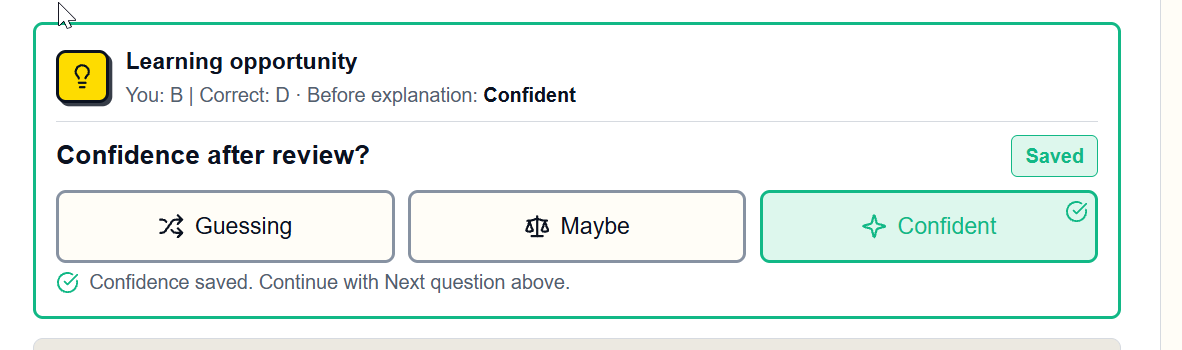
Try this: Before checking an answer, record whether you're confident, unsure, or guessing. Use fresh questions or return after time away. Explain the reasoning without relying on the answer letter.
Evidence of a pass: You can distinguish a familiar answer from understanding and choose what to repair.
Watch test 5 on YouTube · 09:54
5. Does it deliberately bring older material back?
Reaching a later chapter doesn't tell you what remains from the earlier ones. Look for a review process that continues while you learn new material.
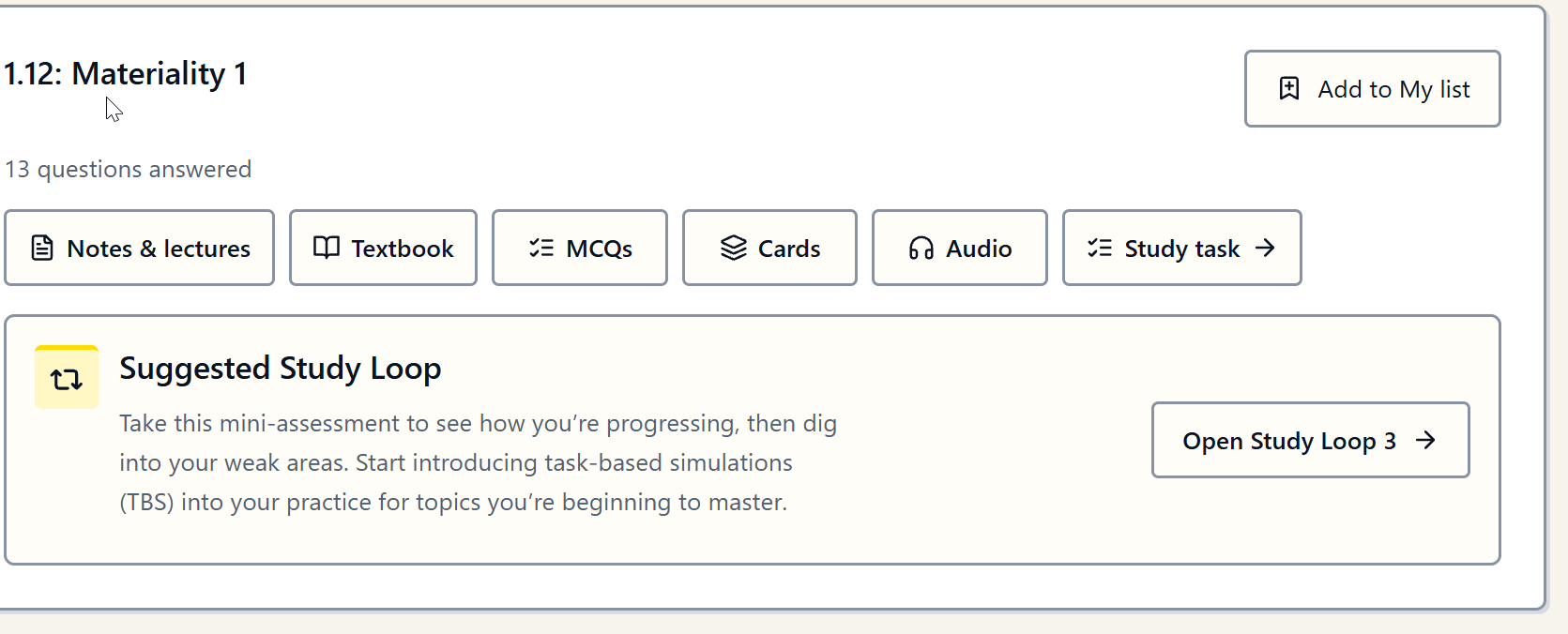
Try this: Find scheduled cumulative review. Return to an earlier topic after time away and attempt questions without notes. Compare that experience with answering immediately after a lesson.
Evidence of a pass: Earlier material returns before final review, and you can see what needs another pass.
The Kesler walkthrough uses Study Loops to revisit material. In a brief trial, you can inspect that workflow; you can't prove long-term retention. Mark that part Not verified until you've had time to return and test it.
Keep notes as you compare: open the free checklist.
Watch test 6 on YouTube · 11:47
6. Does it help you choose what to study next?
You have an hour and several topics competing for it. A dashboard is useful if it helps you decide what deserves that hour.
Try this: Choose one next task from your practice evidence. Explain why: a mistaken rule, uncertain knowledge, trouble recalling older material, or too few attempts to judge?
Evidence of a pass: You can connect a result to an action while distinguishing weak performance from insufficient evidence.
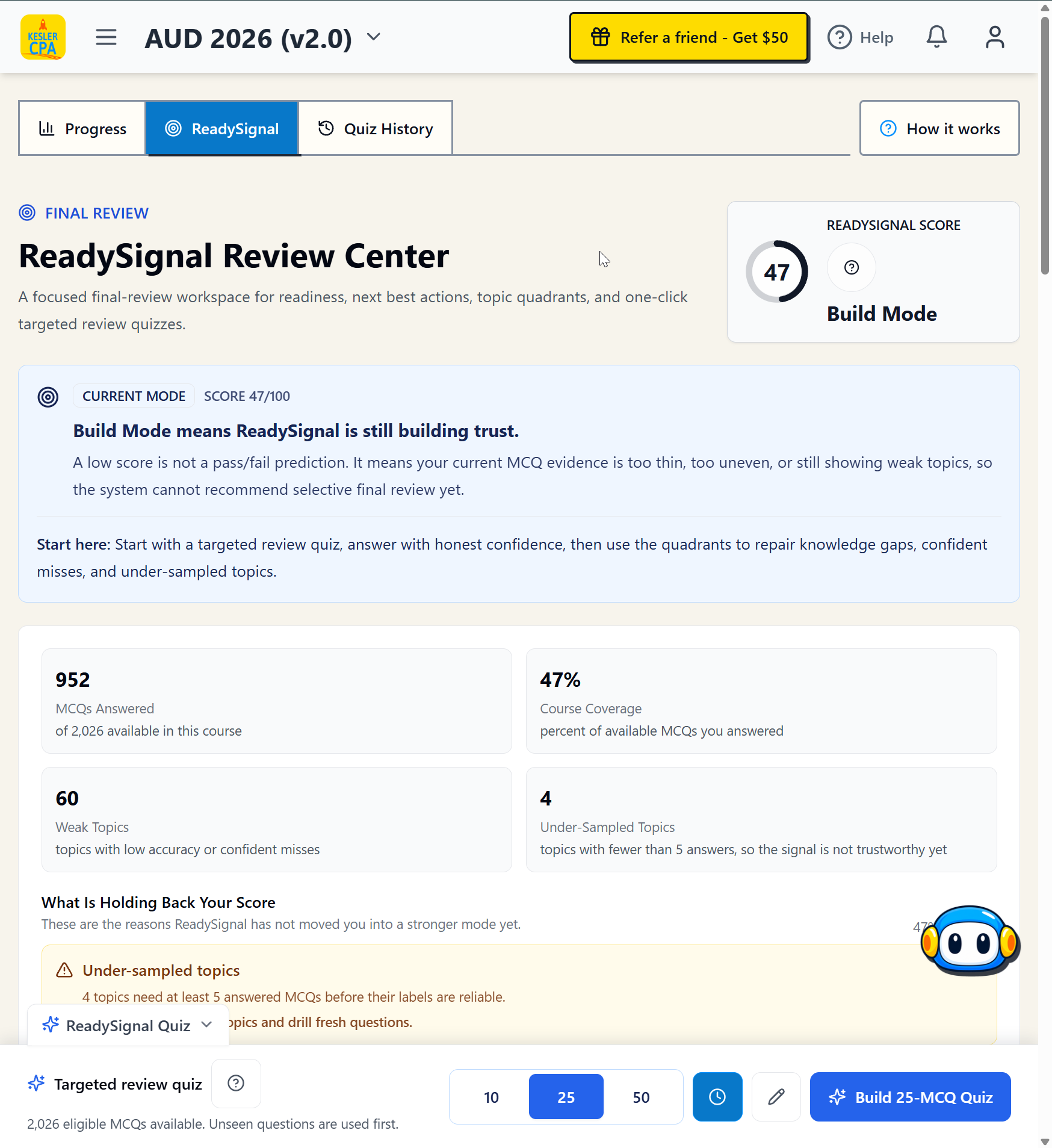
Kesler's ReadySignal uses mapped MCQ accuracy, your confidence choices, quiz history, and topic coverage to prioritize study. It needs sufficient evidence and honest inputs. ReadySignal is review guidance, not a CPA exam score predictor. For a step-by-step example, see how to turn practice results into your next study session.
Watch test 7 on YouTube · 13:39
7. Does it train task-based simulation execution?
A task-based simulation (TBS) asks you to work through a task using the information provided. Recognizing a familiar MCQ answer doesn't show how you'll organize exhibits or complete several connected steps.
Try this: Attempt a simulation. Read the requirement, identify relevant exhibits, complete the work, and track your time. Review where your process went off course.
Evidence of a pass: Practice and feedback help you improve execution: interpreting the task, using evidence, applying rules, and managing time.
The video demonstrates Kesler's simulation workspace. Inspect the task-based simulation practice you can access, and ask for a demonstration if your trial restricts it. A locked feature is Not verified, not proof that the course lacks it.
Watch test 8 on YouTube · 15:26
8. Is there a real final-review process?
Imagine you're ten days from your exam. That's a scenario, not a recommended review duration. Can you explain how you'll use the time remaining?
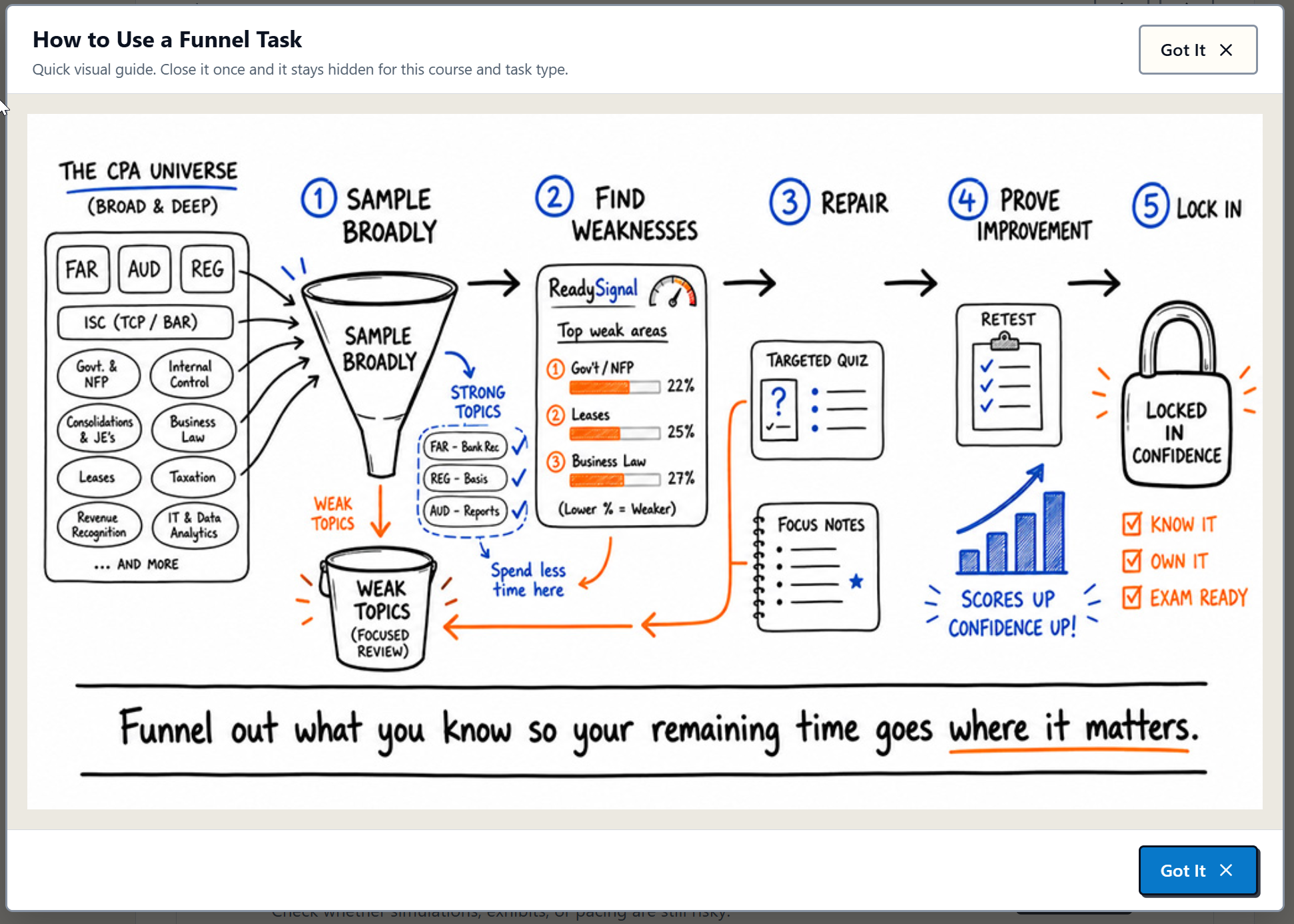
Try this: Find the sequence for broad practice, identifying gaps, targeted repair, retesting, and timed rehearsal. Ask to see it if trial access is limited.
Evidence of a pass: You can narrow review to specific weaknesses while also rehearsing timing, question groups, breaks, and sustained concentration.
Kesler's Study Funneling process narrows the work toward weak, high-priority areas. Mock exams add rehearsal. Neither a completed funnel nor a mock score guarantees an exam result. Look for what you would change after reviewing the evidence. See how quizzes, practice exams, and mock exams serve different purposes when you plan that review.
Watch test 9 on YouTube · 18:34
9. What changes after a failed attempt?
A disappointing result doesn't tell you, by itself, whether to relearn content, change your review habits, practice simulations, or work on timing. Your next plan needs more detail.
Try this: Ask how the course approaches a retake. Look for fresh practice that helps examine content, retention, familiar questions, simulation execution, timing, and final review.
Evidence of a pass: New evidence changes the plan. Restarting chapter one is a considered choice rather than an automatic response.
The video walks through Kesler's Retake Study Funnel: establish fresh evidence, find gaps, repair, retest, and rehearse. Your previous result gives context; it isn't a complete diagnosis of your knowledge today. See the deeper guide to building a retake plan from learning evidence.
Watch test 10 on YouTube · 20:38
10. Will you use it when life gets busy?
Tuesday. 9:30 PM. You have 45 minutes. Try the course in that version of your life, not only on a quiet Saturday when everything feels possible.
Try this: Complete one realistic evening session on the device you'll actually use. Notice how quickly you can find a task, do meaningful work, take a short break, and resume.
Evidence of a pass: You finish a manageable task and can picture returning tomorrow.
Kesler's Focus Timer lets you set focused blocks with short breaks between them. Try it if structure helps. Games, XP, and streaks are optional engagement features, not evidence that you've learned a topic or will pass. Your course doesn't need a virtual pet to work for you. If you study across devices, inspect the mobile and desktop web app and try your usual task on the device you plan to use.
Keep your course, fill a gap, or switch?
Seven passes aren't a scientific course grade. A missing process for the problem you face every night matters more than a feature you'd rarely use. Circle your two most important tests and read the observations behind those results.
- Keep what works. If you understand the teaching and can plan, practice, and review effectively, another purchase may add little. Try correcting the study habit first.
- Supplement a defined gap. If your core course works but you need another explanation or a review process, give the additional resource one job. Avoid doubling every lecture and reading assignment.
- Compare a replacement. If both the teaching and daily workflow remain a poor fit after a fair trial, test another full course. Include the time needed to move, access terms, and any employer requirements in that decision.
The worksheet has blank columns for Kesler, Becker, UWorld, and Gleim. None is pre-scored. Open the comparison worksheet and record what you actually observed.
If a supplement seems appropriate, read about using Kesler alongside another course before adding a second set of materials.
Try CPA review courses before you buy
Use the same difficult topic and comparable effort where possible. Record restrictions as carefully as features. These links lead to provider pages where you can explore current trial access; they don't all open a trial registration screen directly.
Affiliate disclosure: I created Kesler CPA Review. These course links include affiliate links, and I may earn a commission if you purchase through them.
| Course | Next step |
|---|---|
| Kesler CPA Review | Explore the Kesler trial |
| Becker | Explore Becker trial options |
| UWorld | Explore UWorld trial options |
| Gleim | Explore Gleim trial options |
Check each destination for current access, included content, and signup terms. The Kesler Free Trial is a limited preview with paid content behind a paywall.
Need a starting point? Use the free study personality quiz to choose activities to test. Treat the result as a prompt for experimentation, not a permanent learning label.
Give Kesler one real study problem
I built Kesler as a complete CPA review course that you can also use alongside another course. Use a trial to decide whether its approach helps with your actual problem. Here's a suggested first 45 minutes:
- 5 minutes: plan. Choose your section, realistic study capacity, and one difficult topic. Decide whether you're testing a primary course or a supplement.
- 10 minutes: learn. Open a Bite-Sized Video Lesson or Study Notes. Try another format only if you need a different explanation.
- 15 minutes: practice and review. Answer questions with honest confidence ratings. On a miss, use the reasoning or Learn N GO MCQ Explanation to identify your error.
- 10 minutes: save and retest. Record an unresolved issue in Focus Notes or save a takeaway. Try a fresh question on the concept if one is available.
- 5 minutes: choose the next action. Write what helped, what remains unclear, and what you'll do next.
This tests initial fit. Retention, cumulative review, and evidence-based guidance take more time and practice history to assess. If the trial doesn't expose a needed workflow, ask to see it before deciding. For the broader product overview, read how the complete Kesler course works.
One last check before you pay
Confirm the section and package you need, included tools and support, access length, updates, total cost, renewal and cancellation rules, retake support, and any employer reimbursement conditions. Save the terms that apply to your purchase. For Kesler's current membership options, View Pricing.
Common questions about choosing a CPA review course
What should I look for in a CPA review course?
Look for a clear daily plan, explanations you can apply, useful feedback, cumulative review, simulation practice, and a final-review process. Use the ten tasks above to see those processes in action. The right format is one you can work with consistently.
How do I compare CPA review course free trials?
Pick a difficult topic, spend comparable time in each course, and write down specific evidence. Record locked features or insufficient practice history as Not verified. Ask for a demonstration before treating an inaccessible feature as missing.
Should I switch courses or add a supplement?
Start with the gap. If your main course teaches well and supports your daily work, a targeted supplement or a change in study habits may be enough. Compare a replacement when the teaching and overall workflow remain a poor fit.
Can a short trial prove a course will help me pass?
No. A trial can reveal whether you understand the explanations and can use the workflow. It can't establish long-term retention or guarantee an exam result. Keep checking fresh practice, delayed recall, simulation execution, and timing as you study.
Does a higher practice score mean I'm ready for the CPA exam?
It may reflect improvement, familiar questions, or both. Examine your reasoning on fresh and delayed questions, along with confidence, simulation work, and timing. Don't convert a practice score or ReadySignal indicator into a predicted CPA exam score.
Start with one trial session and one written observation. Save the checklist so you can compare evidence while it's fresh.