
Inside Kesler's student data · Study 08
Just Take More CPA Practice Quizzes? Give Your Next Quiz a Job.
The myth: just keep taking CPA practice quizzes. The format doesn't matter as long as the question counter keeps moving.
Finish a set. Check the percentage. Launch another. It's a wonderfully simple plan until the same weak topic follows you into the next quiz like an unpaid invoice.
Give your next quiz a job before you start it. Learning a new rule, checking an older topic, investigating a weakness, and rehearsing an exam session ask different things of you. Choose the format for that job, then use your answers and honest confidence ratings to decide what happens next.
Our student records show why “my quiz score” needs more context. One selected student who reported passing FAR with 81 had recorded accuracy ranging from 45% in Smart Practice to 72.9% in mock MCQ testlets. Another passing history showed a different pattern. A percentage without the quiz type and answer count leaves out much of the story.
These are selected reporting students, not all Kesler customers or everyone who passed with Kesler. The records describe cumulative practice, not a measured sequence of learning phases. Historical item-level confidence ratings are unavailable; the confidence guidance below explains how to use your own data. Sample and methods.
Your Quiz History Isn't One Interchangeable Percentage.
Example A · FAR · Reported Pass: 81
Example B · ISC · Reported Pass: 84
The FAR example includes 207 scored study-task answers at 67.1%, but only 20 Smart Practice answers at 45%. That small Smart Practice sample deserves a different interpretation from hundreds of answers. It doesn't establish that Smart Practice was less useful, or that the student was less prepared when taking it.
The ISC example reported a pass of 84. Its loop accuracy was higher than its task accuracy, the reverse of the FAR example. Its game percentage came from just nine scored answers. Check the denominator before you let a percentage set the mood for your evening.
Variety alone isn't the lesson, either. The selected non-passing AUD record, with a reported score of 52, contains activity in all six categories shown in the FAR chart. Opening every tool is not a passing strategy by itself. The useful question is what each session reveals and what you change afterward.
Choose the Format That Answers Your Study Question.
Here are the main ways to use Kesler practice. This is a menu of study jobs, not a checklist you must complete every day or a sequence reconstructed from these students.
Custom quizzes are a product option, but aren't included in this packet's paired accuracy comparisons. “Other” activity in an analytics export is a reporting category, not another feature you need to hunt down.
The Scores Don't Form a Neat Learning Ladder.
You might expect learning-task accuracy to start low and every review format to score higher. That isn't the average pattern in this snapshot. We compared study-task accuracy with another quiz type within the same passing student-section record, then averaged those differences.
How Much Higher Was Task Accuracy on Average?
Task accuracy minus comparator accuracy, in percentage points. Passing section records with 200+ MCQs and both quiz types.
Task accuracy was higher on average in all five comparisons. That does not make study tasks the winner or games the loser. The pairs use different, overlapping contributor sets and different questions, with possible repeats and targeted selection. They are differences across formats, not measured improvement over time.
Use the comparison to change how you read your dashboard: ask which questions were selected, how many you answered, whether you remembered them, and what you were trying to test. You cannot explain a score change merely by labeling one session “learning” and another “review.”
A Correct Answer Can Still Belong on Your Repair List.
Kesler's choices are Guessing, Maybe, and Confident. They record your judgment of your understanding. They are not calibrated probabilities, and “Confident” is not a substitute for explaining the answer.
Red Flag · Confident + Wrong
Repair the Rule You Trusted.
Name the mistaken assumption or missed condition. Review it before another targeted quiz, then check whether you can apply the correction without help.
Red Flag · Guessing + Correct
Keep the Uncertainty Visible.
A lucky answer is still a useful lead. Explain why it works, then use a fresh question or later loop to test the reasoning. Don't remove the topic just because the mark is green.
| Your Result | A Useful Next Study Job |
|---|---|
| Confident + wrong | Repair the mistaken rule with the lesson or explanation, then check it in targeted practice. |
| Maybe + wrong | Identify the distinction you couldn't settle. Review it, then build a focused quiz or use the relevant task. |
| Guessing + wrong | Establish the missing knowledge before expecting another set to fix it. Return to topic learning and associated practice. |
| Guessing + correct | Verify understanding on a fresh or later question. Keep the topic in the follow-up list. |
| Maybe + correct | Name the remaining uncertainty, then check that distinction in a loop or targeted set. |
| Confident + correct | Check that your reasoning holds beyond a familiar answer. If fresh and later checks support it, reduce immediate repair time and maintain mixed review. |
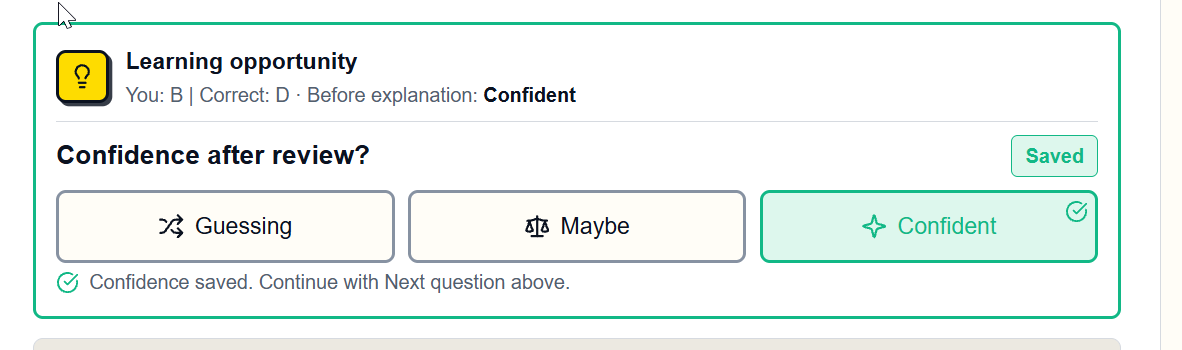
Confidence after review is a separate check-in. An explanation can look obvious while it is on screen. Record that honestly, then test it later with the explanation closed. Don't retroactively turn “I guessed” into “I knew it.”
ReadySignal combines mapped accuracy, confidence, quiz history, and topic coverage to help prioritize review. It needs enough evidence and honest inputs. No activity or only a few attempts cannot establish strength, and neither a confidence choice nor ReadySignal predicts your CPA exam score.
The matrix is editorial guidance for your study decisions. These exports do not include the historical item-level confidence data needed to compare passing and non-passing students' confidence patterns.
Start With the Question Your Quiz Should Answer.
“Do more MCQs” describes activity. “Find out whether I can apply this rule among other topics” describes a purpose. That purpose tells you what to select and what to inspect afterward.
A hypothetical session: a mixed custom quiz exposes a confident mistake on an older topic. Pause the question grind long enough to repair the rule. Use focused questions to check the correction, then return to it through a Study Loop or later mixed set. You changed formats because the evidence changed the job.
- Name the uncertainty. Is this new learning, an unresolved misconception, an older topic, broad final review, or session execution?
- Choose the format and workload. Pick a quiz that can answer that question. You don't need to visit every tool to have a useful session.
- Record confidence and inspect the result. Include guessed-correct answers, small denominators, familiar questions, and gaps in coverage.
- Schedule the repair and another check. Use the relevant explanation or lesson, then verify application without help. Keep broader coverage, simulations, and rehearsal in the plan.
Your Next-Quiz Note
The question this quiz should answer: ______
The format and topics I'll choose: ______
The result and confidence signal I'll inspect: ______
The repair and follow-up check: ______
The better recommendation: choose the study job first, the quiz format second, and the next action from your evidence. Different formats give you different ways to investigate your preparation. Their value comes from what you learn and do next, not collecting a matching set of percentages.
You can use this decision process with your existing course. For a deeper walkthrough of using mapped practice and confidence, see how to turn practice results into your next study session.
Explore How the Formats Fit Together.
The Kesler CPA Review Free Trial is a limited preview of the study workflow and explanations, with paid content behind an in-app paywall.
Explore the Free TrialSample, Sources, and Limits
First-party analysis by Kesler CPA Review. Snapshot: September 29, 2026, 12:45 UTC. Outcomes are selected student reports, not independently authenticated in this analysis.
Read the Supporting Tables and Calculation Details
| Comparator | Passing Pairs / Students / Difference | Non-Passing Pairs / Students / Difference |
|---|---|---|
| Smart Practice | 16 / 14 / +8.04 | 1 / 1 / +1.26 |
| Study Loops | 21 / 14 / +1.25 | 1 / 1 / +2.32 |
| Question-based games | 13 / 10 / +14.27 | 1 / 1 / +31.62 |
| Funnels / retakes | 23 / 14 / +3.84 | 1 / 1 / +5.84 |
| Mock MCQ testlets | 12 / 8 / +2.21 | 1 / 1 / +14.25 |
| Quiz Type | Scored Answers | Accuracy |
|---|---|---|
| Study tasks | 207 | 67.1% |
| Smart Practice | 20 | 45% |
| Study Loops | 90 | 54.4% |
| Question-based games | 73 | 56.2% |
| Funnels / retakes | 64 | 56.3% |
| Mock MCQ testlets | 144 | 72.9% |
| Quiz Type | Scored Answers | Accuracy |
|---|---|---|
| Study tasks | 308 | 62.3% |
| Smart Practice | 0 | Unavailable |
| Study Loops | 105 | 69.5% |
| Question-based games | 9 | 44.4% |
| Funnels / retakes | 110 | 73.6% |
| Mock MCQ testlets | 0 | Unavailable |
| Quiz Type | Scored Answers | Accuracy |
|---|---|---|
| Study tasks | 654 | 61.6% |
| Smart Practice | 560 | 60.4% |
| Study Loops | 172 | 59.3% |
| Question-based games | 10 | 30% |
| Funnels / retakes | 199 | 55.8% |
| Mock MCQ testlets | 38 | 47.4% |
- Scope: the 200+ recorded-MCQ sample contains 26 students and 37 current section results: 31 reported passes and six non-passes. Self-selected Survivor submissions from paid-use customers are not all Kesler users or all who passed with Kesler. Recruitment and submission-incentive details were not established. No population or feature-user pass rate.
- Paired calculation: for each section with scored answers in both types, calculate task correct/scored minus comparator correct/scored, then average with equal section weight and express in percentage points. Contributor sets differ and overlap; repeated students are not independent. The five passing pair counts must not be added together as unique people.
- Non-passing pairs: each comparison has only one non-passing section contributor, the same AUD record. These differences are shown in the table for completeness, not as a reliable failing-group pattern.
- Examples: anonymous FAR/ISC passing records illustrate different patterns; AUD non-pass is a counterexample, not a matched control. Scored answers may include repeats. Some detail histories recover older answers: the AUD Smart Practice and funnel rows include 25 and 30 recovered answers. Do not combine these with normalized aggregates into answer shares.
- Classification: study tasks count associated MCQ activity, not completed assignments. Standard and retake funnels are combined. Game counts cover question activity, not entertainment-only play. Mock MCQs are not full-mock scores. Custom/other categories are outside these paired comparisons; selected profile rows are not the entire activity history.
- Interpretation: cumulative histories do not show chronological phases, first-attempt learning gains, controlled difficulty or an optimal format sequence. Selection, repeats, prior preparation, other resources, timing and coverage are uncontrolled. Missing activity is not proof of nonuse. No effectiveness ranking, cause of passing, score cutoff or calibrated confidence probability is established.
Three source hashes and three profile copies matched originals; both aggregate subsets reconciled; all ten paired comparisons and selected example arithmetic independently checked. These are consistency checks, not authentication of exam outcomes.
Prepared with AI assistance and checked against retained sources on September 29, 2026. Product descriptions checked against current Kesler product pages and the linked course-trial walkthrough. No separate human expert review claimed. The chooser, confidence matrix, and study routine are editorial recommendations.