
Inside Kesler's student data · Study 04
Are All CPA Practice Questions Equally Useful? Let Your Data Decide.
The myth: all CPA practice questions are equally valuable, so your job is to keep working through them all.
It's a wonderfully tidy plan. Every question gets one vote. The concept you can explain in your sleep gets the same attention as the rule you keep getting confidently wrong.
Your next study session deserves a more useful selection process. In selected Kesler student records, we found substantial Smart Practice and funnel activity alongside reported passes in AUD, REG, and FAR. We also found students who used targeted tools and reported non-passing results.
The recommendation is to let your own evidence choose the next task: what you missed, what you guessed correctly, what you were sure about but misunderstood, and what you haven't practiced enough to judge.
We reviewed a selected sample of reported outcomes, not all Kesler users or all students who passed with Kesler. These records describe tool use; they do not prove which individual questions produced the most learning. The confidence-based routine below is our recommendation, not an observed cause of these results. Sample and methods.
Passing Records Included Hundreds of Targeted-Practice Answers.
These three anonymous examples come from different students in the retained 200+ multiple-choice question (MCQ) detail profiles. They were selected to illustrate substantial recorded use, not to represent the typical student.
- Example A · AUDReported Score: 75
-
862 Smart Practice answers.
624 combined Study Funnel / Retake Study Funnel answers. - Example B · REGReported Score: 84
-
463 Smart Practice answers.
216 combined Study Funnel / Retake Study Funnel answers. - Example C · FARReported Score: 76
-
205 Smart Practice answers.
425 combined Study Funnel / Retake Study Funnel answers.
In these exports, Study Funnel and Retake Study Funnel questions share one combined category. The figures do not tell us that each student used both workflows separately.
There is a counterexample worth keeping beside those passes: a non-passing AUD record with a reported score of 52 contains 560 Smart Practice answers and 199 combined funnel answers. Using the tools is not the same as demonstrating that every gap is repaired.
| Example / Reported Result | Smart Practice | Combined Funnels |
|---|---|---|
| A · AUD pass, 75 |
862 | 624 |
| B · REG pass, 84 |
463 | 216 |
| C · FAR pass, 76 |
205 | 425 |
| D · AUD non-pass, 52 |
560 | 199 |
Scores are self-reported; practice counts are scored answers, not unique questions or hours. Detailed histories can include recovered answers, so these counts should not be divided by normalized overall-MCQ totals. The examples are not matched controls.
The Funnel Pattern Was Different. Smart Practice Use Alone Wasn't the Answer.
Among selected section records with at least 200 MCQs, combined funnel activity appeared in 23 of 31 passing records and one of six non-passing records. Five of the six non-passing records had no recorded funnel activity.
Smart Practice tells a different story: it appeared in 19 of 31 passing records and all six non-passing records. We cannot honestly turn that into “the students who failed didn't use Smart Practice.”
Recorded Use Within Each Outcome Group
Study Funnel / Retake Study Funnel
Smart Practice
Nor was the Smart Practice percentage a clean separator. In the broader sample with no MCQ minimum, average section-level Smart Practice accuracy was 66.6% across 21 passing scored sections and 66.9% across nine non-passing scored sections.
What this changes: inspect whether your practice leads to a specific repair and a follow-up check. A feature-use checkmark or a reassuring percentage cannot answer that for you.
The funnel difference is an observation worth examining, not proof that funnels caused passing. The groups are small and unequal, other preparation varies, and missing recorded activity is not proof a tool was never used.
Give Each Targeted Tool a Clear Job.
- Choose Focused PracticeSmart Practice
- Use targeted question work to follow up on review priorities. Kesler's ReadySignal uses mapped MCQ accuracy, your confidence choices, quiz history, and topic coverage to help prioritize what to study next.
- Narrow Final ReviewStudy Funnel
- Start with broad practice, identify weak areas, focus your review and targeted quizzes, then retest. The point is to turn “review everything” into a concrete repair list while continuing broader preparation.
- Rebuild After a ResultRetake Study Funnel
- Establish fresh evidence, find gaps, repair them, retest, and rehearse. Your previous exam result provides context; it doesn't tell you exactly which rule you understand today.
These are distinct study workflows. Their product purpose should not be confused with what the export proves: it records classified question activity, not a verified replay of each student's decisions or completion of every step.
See the ReadySignal prioritization example, Study Funnel walkthrough, and Retake Study Funnel walkthrough. ReadySignal is review guidance, not a CPA exam score predictor.
A Green Answer Can Still Be a Red Flag.
Kesler's confidence choices are Guessing, Maybe, and Confident. Use them honestly. “Confident” means something different when you could explain your answer than when you vaguely recognized the letter from yesterday.
Combine the result with how sure you were when answering. Here's how we recommend turning that combination into a next action:
Red Flag · Mistaken Rule?
Confident + Wrong
You trusted an answer that didn't hold up. Find the rule, assumption, or overlooked condition behind it. Write the correction, then check it on another question.
Red Flag · Uncertain Knowledge
Guessing + Correct
The result is green; the reasoning is still unverified. Explain why the answer fits and why the alternatives don't. Follow up before treating the topic as learned.
Learning Task
Guessing or Maybe + Wrong
Identify what was missing: the rule, the setup, or how to apply it. Return to the relevant explanation or lesson, then practice that specific gap.
Maintain and Verify
Confident + Correct
Encouraging evidence, especially when you can explain it. Check whether the reasoning holds on a fresh or later question and in mixed practice. One correct answer is not mastery.
What about Maybe + correct? Keep the uncertainty visible. Name the part you weren't sure about and check it again. It deserves a different follow-up from a confident answer supported by sound reasoning.
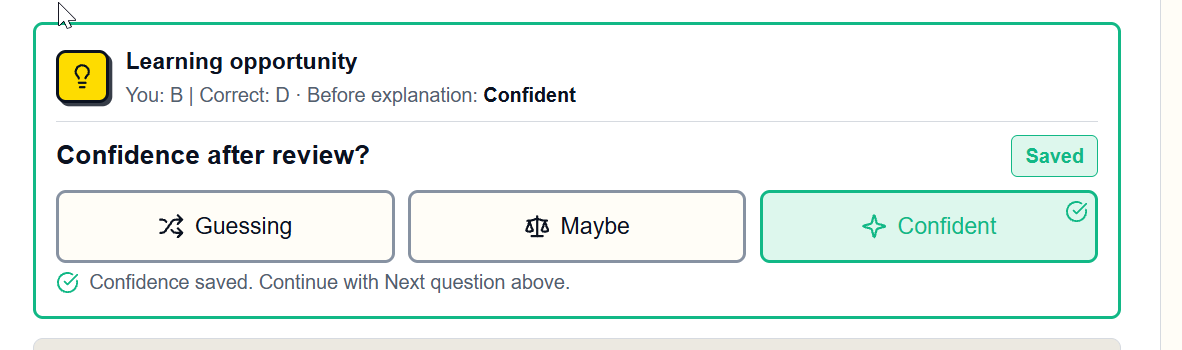
Keep before-answer confidence separate from after-review confidence. An explanation can make sense while it's open. That doesn't demonstrate that you can apply the rule unaided tomorrow. Update the review rating honestly, then leave yourself a follow-up question rather than mentally rewriting the original guess as “I knew it.”
Your confidence entries make your data more informative only when they reflect what happened. These research exports do not contain the students' historical item-level confidence ratings, so the matrix is practical guidance—not a finding about why these particular students passed or failed.
Let Your Own Data Choose the Next Useful Question.
If you have a recurring confident-wrong error and a topic you can explain on fresh questions, those two topics don't need identical treatment in the next session. Give the unresolved issue a specific job in your plan.
- Choose a priority from your evidence. Look for a repeated mistake, a correct guess you can't explain, or a topic with too little practice to judge. Low coverage calls for sampling; it doesn't automatically prove weakness or strength.
- Name the error before launching another set. Write the distinction you missed. “I mixed up these two recognition rules” is actionable. “My score is bad” is not a review task.
- Repair, then check without the explanation. Use the relevant lesson or Learn N GO MCQ Explanation. Attempt a fresh question on the concept where available, explain your reasoning, and record confidence honestly.
- Return to it in broader practice. See whether you can identify the right rule among other topics and after time away. Keep unresolved issues scheduled while continuing section coverage, task-based simulations, and appropriately timed mock exams.
A hypothetical example: you get a revenue-recognition question right by guessing. A second question exposes a rule you were certain about but had reversed. Both deserve review, even though your dashboard counted the first as a success. Your next task is to explain the distinction and apply it to another scenario—not to collect another easy green answer on an unrelated topic.
Replace “every next MCQ deserves equal attention” with this: use accuracy, confidence, coverage, and follow-up results to decide what you need to learn next. Then choose the practice that checks that need.
The passing histories show targeted formats used as part of preparation. The non-passing histories show why clicking the same tools is not the whole answer. Your useful output is an updated understanding and a next task—not just a larger activity total.
You can keep this kind of error-and-confidence log in your current course. Kesler connects review signals, explanations, and targeted practice in its study workflow. For more detail, use our practice-results planning guide or the retake planning guide.
Try It on a Topic You're Unsure About.
Explore the Kesler CPA Review Free Trial to inspect the explanations and study workflow. The trial is a limited preview with paid content behind an in-app paywall.
Explore the Free TrialSample, Sources, and Limits
First-party analysis by Kesler CPA Review using retained product analytics and selected student-reported section outcomes. Comparison snapshot: September 29, 2026, 12:45 UTC. The examples are anonymous analytical records, not student testimonials or independently authenticated exam scores.
Read the Comparison Table and Measurement Details
| Practice Type | Passing Records | Non-Passing Records |
|---|---|---|
| Study Funnel / Retake Study Funnel | 23 of 31 | 1 of 6 |
| Smart Practice | 19 of 31 | 6 of 6 |
- Selection: the 200+ recorded-MCQ subset contains 26 reporting students and 37 current section results: 31 passes and six non-passes. The broader no-minimum sample contains 34 students and 50 results: 37 passes and 13 non-passes. Students can contribute multiple sections; samples overlap and must not be added together. Neither enumerates all Kesler customers or successful students.
- Examples: three distinct passing students selected for substantial Smart Practice and combined funnel activity, plus a non-passing AUD counterexample. Two passing profiles supplement the original article packet from the same supplied research dataset. These are illustrative, not representative or matched controls.
- Classification: Smart Practice includes the ready_signal_review quiz source and quiz names beginning Smart Practice. Study Funnel and Retake Study Funnel activity are merged as funnel. No separate outcome comparison between those workflows is supported.
- Measurement: charts use normalized recorded-use counts. Example rows use detailed scored-question histories, which may recover older answers. The non-passing example includes 25 recovered Smart Practice and 30 recovered funnel answers; its 199 detailed funnel answers therefore differ from the normalized 169. Counts can include repeats and earlier study cycles through the reported exam date, not unique questions or study hours. No recorded use is not proof of nonuse.
- Accuracy: the broader Smart Practice means equally weight the 21 passing and nine non-passing sections with scored activity. Different questions and contexts prevent causal interpretation. A lower practice percentage may have several explanations; the dataset does not establish which one applies.
- Limits: outcomes are self-reported; recruitment and submission-incentive details were not established in the snapshots. Prior preparation, other courses, difficulty, section mix and timing are uncontrolled. Historical item-level confidence ratings, timestamped pre-exam ReadySignal values and validated predictions are unavailable. No feature effect, customer pass rate or exam-readiness threshold is claimed.
Source checks matched original/supplemental provenance, reconciled comparison rows and checked detailed example counts. They establish file consistency and arithmetic, not official authentication of exam results.
Prepared with AI assistance and checked against retained sources on September 29, 2026. Product definitions and the confidence-controls screenshot were checked against the current course-trial walkthrough. No separate human expert review is claimed. The confidence matrix and suggested routine are editorial guidance, not interventions tested in this sample.